

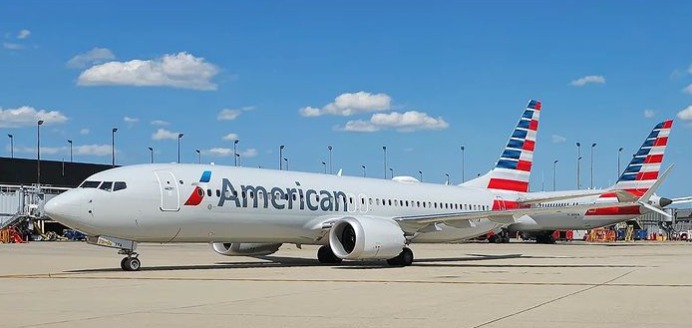
As American Airlines’ “challenging year” continues, amid softening demand and economic uncertainty, the airline reported a net profit of $599 million, dropping from $717 million, in its second quarter earnings report.
The company said the year is “largely unfolding as expected at the start of the year”. Management said it was impacted by collective bargaining agreements along with it being more exposed to domestic travel, which has seen softness this year.
“But we believe the worst is behind us and year-over-year revenue will sequentially improve each month,” management said in its earnings call.
Third quarter non fuel unit costs are expected to be up 2.5 to 4.5% compared to the third quarter last year, driven by collective bargaining agreements ratified over the past two years.
However, management said its operating margin performance year-over-year was “very much in line” with its competitors despite American’s larger exposure to domestic and cost challenges faced as a result of its collective bargaining agreements.
“At least one of our peers isn’t in that position yet, but will be eventually,” said management. “For us to produce the same year over year margin in that environment seems like a really great result.”
Operating margin for the period was 7.9%, down from 9.7%. Unit revenues dipped slightly by 1.5% to 19.96 cents.
The topic of its competitors cropped up several times throughout its earnings call. It follows United CEO Scott Kirby praising Delta Airlines’ performance in its own second quarter results, stating that United and Delta were the only two “brand loyal airlines” in the country.
“We don’t run our airline based on other airlines’ perception of our business,” said American CEO Robert Isom. “The primary differentiator between us and some of our competitors is largely two things: One, we’re paying our team members at market wages while others are benefitting from not doing that, but I’m sure that will catch up over the long run. Secondly, we have a network that is more oriented to the domestic network. Let’s face it: the domestic network has been under stress because of the uncertainty in the economy and the reluctance of domestic passengers to travel. We think that is going to chance. We think domestic is going to be a tailwind for us – especially as demand capacity come back more into balance.”
Domestic unit revenue dropped 6.4% to 17.62 cents and load factor was down 2.8 percentage points to 84.2%. International unit revenue was flat at a positive 2.7% to 15.46 cents and load factor was flat at 85.7%.
Management said third quarter domestic will “be better” than the second quarter. The company added that corporate managed traffic had improved 10% year-over-year in the quarter in a relatively flat business market, signalling its domestic strength.
US president Donald Trump had promised significant 50% tariffs on Brazil imports. This signalled concern for operators of aircraft from Brazilian manufacturer Embraer – including American, which operates the E175.
“We’re working with Embraer on deliveries,” management said in the call. “We don’t anticipate any long-term issues. We know that the Brazilian government is with the administration and Embraer. There’s a tremendous amount of US-based content on those Embraer aircraft and there is a lot that goes into negotiating trade deals. We stand by ready to help in any way and we’ve made sure that the administration and Embraer knows our interests. We’re confident we’ll be taken care of.”
American reported total operating revenues of $14.4bn – relatively flat at a positive 0.4%. Of this, passenger revenues were a negative 0.6% to $13.1bn, while cargo was up 8.2% to $211 million. Other revenues climbed 13% to $1.1bn.
Operating expenses were up 2.4% to $13.3bn. Operating income dropped 18% to $1.1bn.
The company continues its deleveraging goal of total debt below $35bn by the year end of 2027. The company’s total debt is $38bn and a net debt of $29bn as of the end of the second quarter.