

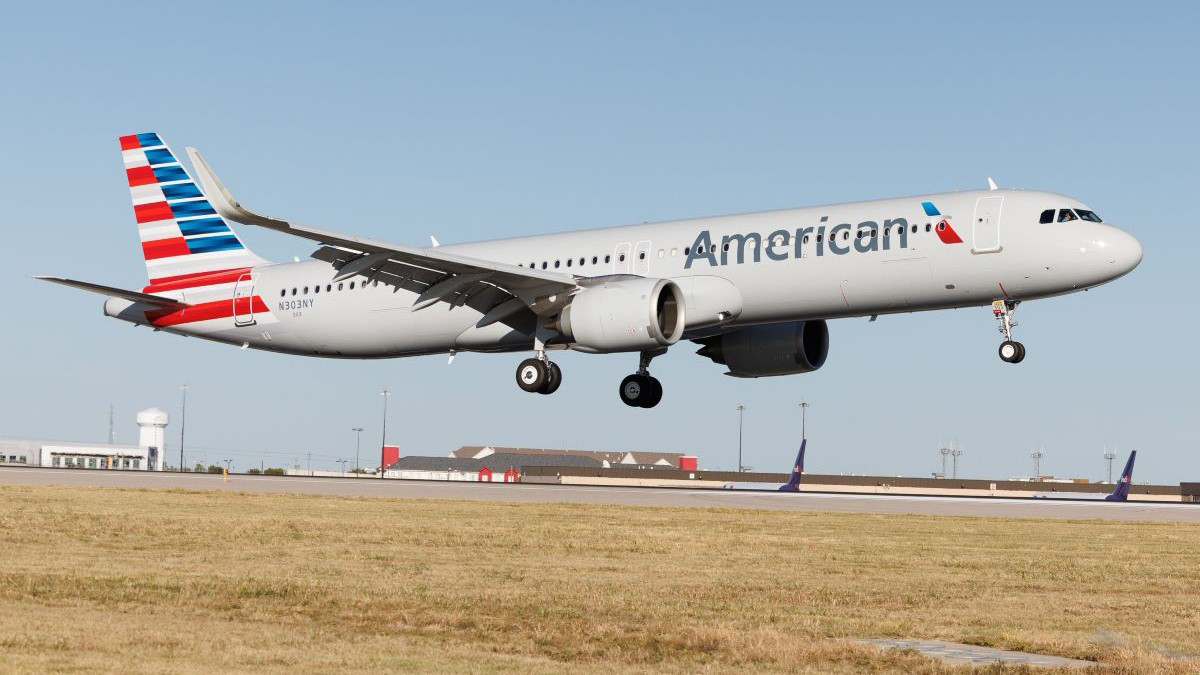
American Airlines has said it plans to carve out a greater share of the international long-haul market for itself as deliveries of the “game-changer” Airbus A321XLR ramp up through 2026.
Speaking at a Bernstein Insights event in Washington, DC on Wednesday, American CEO Robert Isom said the carrier is ready to go on the offensive in the international market, after pulling back during the pandemic.
“For the last few years, there’s been a little bit more margin in international travel than there has been in domestic,” said Isom.
“Fortunately, we’re in a position now where we can start playing a bigger game in that international side of the market as well.”
The key to American’s build-out of its international long-haul network will be the A321XLR.
In 2019, American ordered 50 of these extra-long range aircraft, under a purchase agreement that converted 30 of its existing A321neo orders.
American’s first A321XLR was delivered in October, with its inaugural flight set to take place on December 18, 2025, flying from New York (JFK) to Los Angeles (LAX).
Shortly after receiving the aircraft, American announced that a new service between New York (JFK) and Edinburgh, starting in March 2026, will be its first international use of the aircraft.
The rollout of the A321XLR is also complemented by American’s focus on premium revenue, which it believes has significant growth potential within the long-haul international market.
As such, lie-flat seating on international long-haul routes will grow by 50% “over the next few years”, Isom said, while premium seats will grow by 30% during the same period.
“American's roots are in serving the premium customer, but the great thing that we see now is a mix of leisure customers that want to buy up into that cabin,” the CEO said. “We've got to take advantage of that dynamic, and we are.”
Devon May, CFO of American, added that international capacity growth as available seat kilometres (ASK) will “probably” outpace domestic capacity growth over the next five years, driven by continued expansion of the carrier's long-haul fleet.
At present, American has approximately 135 long-haul-capable aircraft, but is aiming to grow this to around 200 by the end of the decade.
“We have varying flexibility on the A321, so we can move from neos to XLRs as we see fit over the years,” said May. “So there is a lot of flexibility to grow international at an even faster rate.”
Turning to the carrier’s financial health, Isom said American is “on track” to reduce its total debt to $35bn by year-end 2027, as promised in each of this year’s quarterly earnings.
Already, American has reduced its total debt to $36.8bn as of the end of this year’s third quarter — down from $54bn at the height of the pandemic.
In 2024, American also signed a new five-year deal with frontline staff — flight attendants, mechanics, ground workers, and pilots — ensuring cost certainty through 2028.
“Against the backdrop of a really tough year, I’ve got incredible excitement about what comes next, because that is where I think we can really start putting some points on the board,” said Isom.
“I feel great that we’re on track to produce the results that we’ve talked a lot about. Having that fleet in place, having the labour contracts in place, puts us in a position to get back to really tending to our network.”