

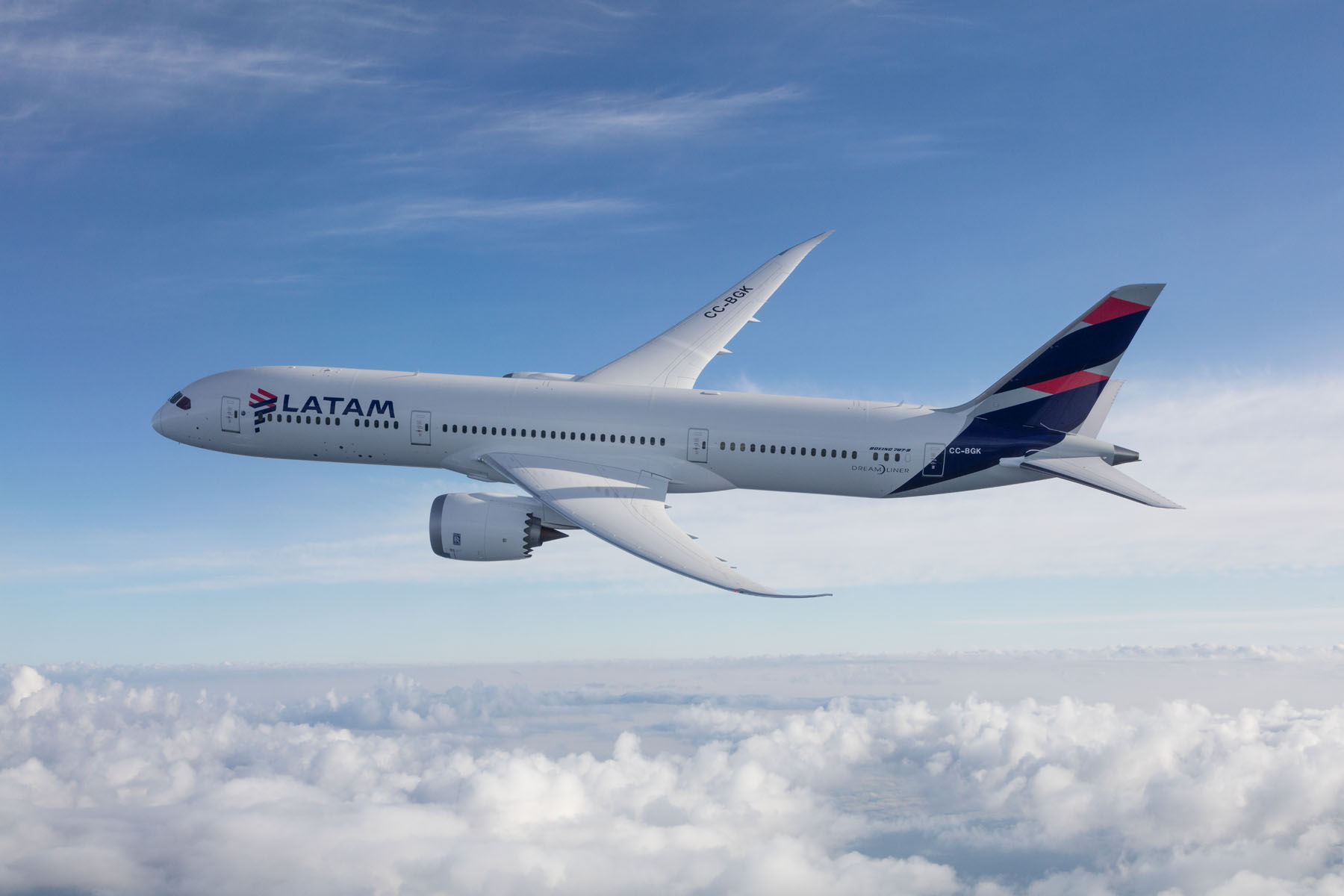
LATAM Airlines Group has unveiled a major strategic push toward higher-margin travel, driven by increased premium capacity, fleet modernisation and expansion, and broader connectivity across Latin America.
At its 2025 Investor Day on Tuesday (December 9), LATAM management laid out the company’s path to “sustainable, profitable growth” through product upgrades, cost discipline, financial strength, and digital innovation.
One of the key features of the plan is the launch of a new premium economy class known as ‘Premium Comfort’ in 2027.
Premium Comfort will offer 50% more open space than economy, with foot-rests, calf-rests, privacy wings, and upgraded onboard service.
Over the next four years, LATAM’s supply of premium seats is expected to grow by 7% annually.
In 2027, using the Boeing 787-9 fleet as a guide, LATAM said the percentage of premium seats on each aircraft will rise to 18% — up from 10% at present.
Paolo Miranda, chief customer and experience officer at LATAM, said that Premium Comfort will be a “segmentation that strengthens the economics of every flight, while improving choice, which is one of our core pillars of the value proposition”.
Roberto Alvo, CEO of LATAM, said the impressive performance of the carrier’s premium offering has highlighted a new “willingness to pay” and a depth of loyalty among customers.
Alvo admits that LATAM "probably missed” these trends a few years ago, but is now repositioning itself to capitalise on them.
Since 2019, LATAM’s premium revenue has more than doubled — from $1.5bn to $3.3bn in 2025. Premium’s share of total revenue has also grown significantly — from 14% in 2019 to 23% in 2025.
Premium revenue growth has comfortably outpaced overall revenue growth, in line with trends seen by major airlines in the US, Europe and the Middle East.
LATAM said these figures support its decision to offer premium seats on all flights — an offer that is “unique” within the region.
Complementing the growth in premium revenue is LATAM’s frequent flyer programme, LATAM Pass, which is the largest in Latin America and the eighth largest in the world.
LATAM Pass currently has more than 53 million members and is tied to eight co-branded cards and over 100 commercial alliances.
As of 2025, 60% of LATAM’s total revenue is generated by LATAM Pass members — up from 35% only a “few years ago”.
Ramiro Alfonsín Balza, chief commercial officer of the Group, noted that LATAM Pass is as large as the three next-largest loyalty programmes in South America combined.
Miranda also picked up on this theme, describing the frequent flyer market as a “continent-sized opportunity”.
“South America's population is about 436 million people, larger than the US, yet when you look at trips per capita, we're talking about 0.5% compared to the US,” he said.
“And this aligns with our strategy of capturing quality share, not just volume. Today, one in every three customers flying to, from, and within South America choose LATAM.”
To support its premiumisation drive and the expansion of its loyalty programme, LATAM is investing heavily in its fleet.
The Group is expecting to end 2025 with a fleet of 371 aircraft, with one additional delivery before year-end.
In 2026, the order book includes 41 aircraft (including 12 E2s), bringing the fleet to 410.
In 2027, the fleet should reach 422, with 27 deliveries, including five Airbus XLRs. From 2028 to 2030, there are 71 aircraft on order.
Balza said the XLRs will be a key feature of LATAM’s future widebody fleet. “We're going to be connecting secondary cities in the US and maybe in Europe with the XLR,” he said.
“We believe it efficiently allows us to expand our international footprint. To give you an idea, from Lima you can reach Chicago, Toronto, or San Francisco with that aircraft.”
The E2 strategy is set to unlock new markets and strengthen the company’s position at key airports.
The Group has 24 firm E2 orders for delivery between 2026-27, which will serve eight new destinations and 16 new routes.
Additionally, it has 50 purchase options for delivery between 2027 and 2030, potentially opening up 35 new destinations in South America.
“The E2 will allow us to unlock new markets, providing a little bit more capillarity to our network,” said Balza.
“It will also strengthen our position in our key airports, providing our corporate customers a little bit more frequencies from certain airports.”
Management emphasised a strategic approach to expanding the network, prioritising profitability over market share.
In addition to growing premium revenues, the company is targeting increased corporate demand, with a focus on key hubs in Sao Paulo, Santiago, and Lima.
In Brazil, the plan includes strengthening its presence in Brasilia and Fortaleza, and enhancing connectivity to secondary cities.
In total, the Group is targeting mid-to-high single-digit capacity growth (ASK) through 2027, while preserving a fleet age of 12 years or less on average — a benchmark designed to keep maintenance costs down and reliability up.
Finally, LATAM reaffirmed its commitment to upgrading the passenger experience across all classes.
The renovation plan includes retrofitting cabins, rolling out onboard Wi-Fi, and increasing lounge access for premium travellers.
Wi-Fi is already available on 95% of LATAM's narrowbody fleet, and the Group will begin rolling out WiFi connectivity across its widebody fleet in 2026.
The company is also focusing on its VIP Lounges – for example, a new premium lounge in São Paulo is set to open in 2027.