

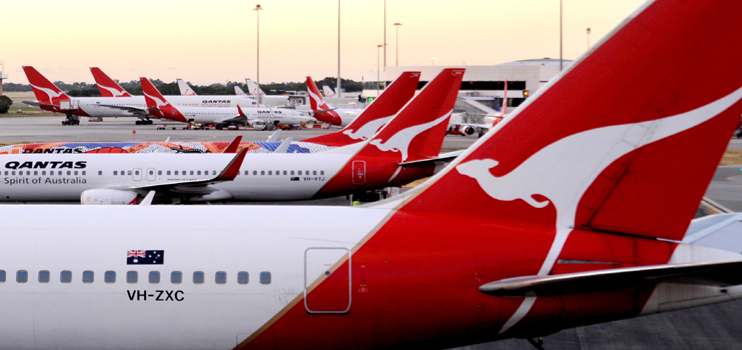
Australian flag carrier, Qantas Group, has warned that surging jet fuel prices linked to the Middle East crisis will significantly increase costs and force operational changes, as it moves to protect margins while maintaining strong travel demand.
Jet fuel prices have more than doubled since the group’s first-half results, with refining margins rising from about $20 per barrel in February to peaks of around $120. Although Qantas has hedged roughly 90% of its crude oil exposure for the second half of the financial year (FY26), it remains largely exposed to refining margins. Fuel costs for the period are now expected at A$3.1-A$3.3 billion.
The airline said it is working closely with the government and suppliers, who have provided confidence over fuel availability through the remainder of April and “well into May”, though it continues to monitor supply chains closely.
To mitigate the impact, the group has implemented a series of measures including international network adjustments, capacity reductions and fare increases. While Qantas does not operate flights to the Middle East, it has supported customers booked via partner airlines by offering rebooking flexibility or refunds. Strong demand for travel to Europe has prompted the airline to redeploy capacity from US and domestic routes to boost services to Paris and Rome.
Managing capacity
Capacity is being actively managed across the group. Domestic capacity will be reduced by around five percentage points in the fourth quarter of FY26, with affected passengers being re-accommodated or refunded.
Across the full year, group domestic capacity is expected to grow around 3%, including +3% for Qantas Domestic and +4% for Jetstar Domestic, though fourth-quarter domestic capacity is broadly flat to slightly negative. Internationally, group capacity is forecast to increase by around 3% for FY26, with Qantas International up 7% and Jetstar International down 3%, reflecting a shift towards higher-yielding routes and ongoing network optimisation.
Revenue trends remain supportive despite the disruption. Group international unit revenue (RASK) growth for the second half is now expected at 4-6%, double previous guidance, while domestic RASK is forecast to rise around 5%, and up to 6% in the fourth quarter.
The group said it retains flexibility to take further action if fuel prices remain elevated.
Financially, Qantas said it remains within its target framework. Capital expenditure for FY26 is now expected at or below A$4.1 billion, the bottom end of previous guidance, while net debt is projected to be around the middle of its target range by June. A planned A$150 million share buyback has been paused due to uncertainty, although a A$300 million interim dividend is proceeding.
Tight fuel markets
Meanwhile, jet fuel markets are expected to remain tight for the foreseeable future. The International Energy Agency said higher prices and supply disruptions have already reduced jet fuel demand in parts of Asia and the Middle East as flight cancellations rise.
And the US Energy Information Administration has raised its jet fuel price outlook for a third consecutive month, forecasting average prices of $3.39 per gallon in 2026, driven partly by tight refining capacity. Refiners, particularly in Asia-Pacific, are cutting run rates due to feedstock shortages while some countries prioritise domestic supply, contributing to ongoing volatility in global jet fuel markets.